
Meta Description: Compare seamless and welded stainless steel pipes. Explore rotary piercing, ERW/EFW welding techniques, joint efficiency factors, bursting pressure calculations, and cost optimization strategies.
Target Keywords: seamless vs welded stainless steel pipe, seamless pipe manufacturing process, ERW stainless steel pipe, longitudinal submerged arc welded pipe, pipe weld joint factor
When engineering fluid handling systems, selecting between seamless and welded stainless steel pipes is a key design decision. The choice directly affects maximum allowable working pressure, mechanical fatigue resistance, non-destructive testing requirements, lead times, and overall project cost.
While seamless pipe historically held a distinct performance advantage, advances in automated welding, in-line weld seam cold-working, and non-destructive examination (NDE) have closed the performance gap for many industrial applications.
1. Manufacturing Process Mechanics
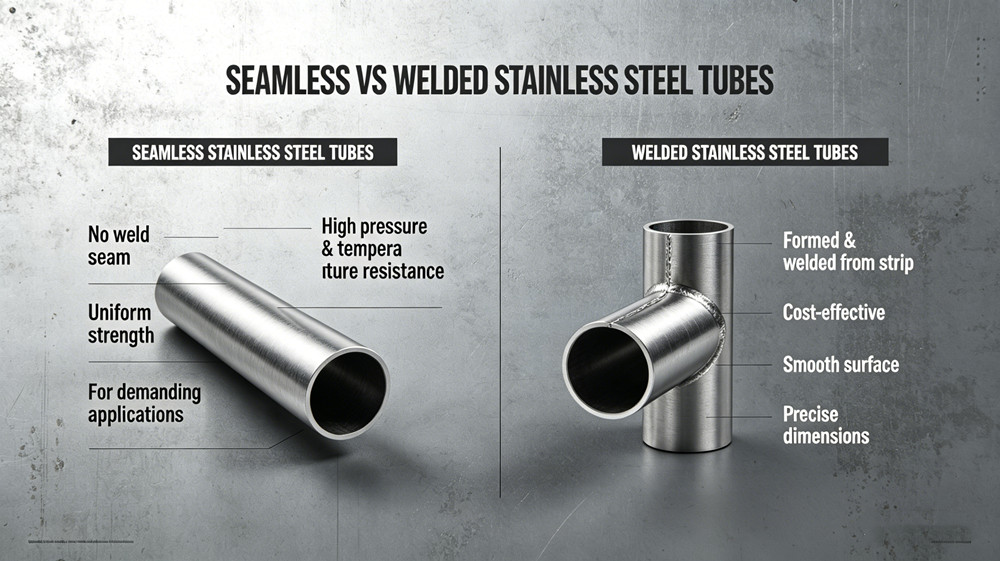
The foundational difference between seamless and welded stainless steel pipe lies in how the hollow cylindrical shape is initially formed.
Seamless Pipe Manufacturing (Hot Rotary Piercing & Extrusion)
Seamless pipe is produced without a welded longitudinal seam, yielding a continuous, monolithic wall structure.
- Billet Heating: A solid cylindrical stainless steel round billet is heated to hot-working temperatures ($1150^\circ\text{C} \text{ to } 1250^\circ\text{C}$).
- Rotary Piercing (Mannesmann Process): Cross-rolls rotate the hot billet at high speeds while forcing it over a stationary piercing mandrel, creating a hollow shell.
- Elongation & Mandrel Rolling: The hollow shell passes through sizing mills or a stretch-reducing mill to achieve the targeted outer diameter and wall thickness.
- Cold Drawing / Cold Pilgering: Precision seamless pipes undergo cold pilgering or die drawing to refine surface quality and tighten dimensional tolerances.
Welded Pipe Manufacturing (Roll Forming & Welding)
Welded pipe is produced from flat-rolled stainless steel strip or plate that is cold-formed into a cylinder and joined along its seam.
- Uncoiling & Forming: A continuous stainless steel strip is passed through successive sets of forming rollers to create a circular cross-section.
- Welding Technologies:
- Electric Resistance Welding (ERW) / High-Frequency Induction (HFI): Joins strip edges using high-frequency current without adding filler metal.
- Gas Tungsten Arc Welding (GTAW / TIG): Uses a non-consumable tungsten electrode with inert shielding gas; ideal for thin-to-medium wall pipes.
- Submerged Arc Welding (SAW / EFW): Utilizes a granular flux cover and consumable filler wire for heavy-wall, large-diameter pipes.
- Bead Working & Annealing: The internal and external weld beads are planished or scarf-trimmed smooth. The pipe then undergoes full inline solution annealing to restore corrosion resistance along the heat-affected zone.
2. Structural Mechanics & Weld Joint Efficiency Factors
In pressure vessel and piping design codes (such as ASME B31.3 and ASME Section VIII), the structural integrity of a welded joint is accounted for using a Weld Joint Quality Factor ($E$).
$$P = \frac{2 \cdot S \cdot E \cdot t}{D – 2 \cdot Y \cdot t}$$
Where:
- $P$ = Internal Design Pressure ($\text{MPa}$ or $\text{PSI}$)
- $S$ = Allowable Material Stress ($\text{MPa}$ or $\text{PSI}$)
- $E$ = Longitudinal Weld Joint Quality Factor ($0.60 \text{ to } 1.00$)
- $t$ = Specified Wall Thickness ($\text{mm}$ or $\text{inches}$)
- $D$ = Pipe Outside Diameter ($\text{mm}$ or $\text{inches}$)
- $Y$ = Temperature Coefficient ($0.4$ for austenitic steel below $480^\circ\text{C}$)
Weld Joint Quality Factor ($E$) Guidelines:
- Seamless Pipe ($E = 1.00$): Because there is no weld seam, seamless pipe receives a full efficiency rating ($100\%$), allowing maximum design working pressures for a given wall thickness.
- Fully Radiographed Welded Pipe ($E = 1.00$): Welded pipes (such as ASTM A312 TP304/316) that undergo $100\%$ non-destructive X-ray examination or eddy-current testing also achieve a joint factor of $1.00$.
- Spot Radiographed Welded Pipe ($E = 0.85$): Reduces allowable design pressure by $15\%$, requiring a thicker pipe wall to meet equal pressure ratings.
- Non-Examined Welded Pipe ($E = 0.70\text{–}0.80$): Reduces allowable pressure by up to $30\%$.
3. Corrosion Resistance along the Weld Seam
A historical concern with welded stainless steel pipe was preferential corrosion attack along the weld seam. This can occur due to micro-segregation of alloying elements during weld pool solidification, chromium carbide precipitation, or surface oxides (heat tint).
Modern manufacturing mitigates these risks through:
- Low-Carbon Chemistries: Using low-carbon grades (304L and 316L) prevents sensitization and intergranular corrosion in the heat-affected zone.
- Post-Weld Solution Annealing: Heating the welded pipe above $1040^\circ\text{C}$ followed by rapid quenching re-dissolves segregated elements, restoring uniform chemical corrosion resistance across the base metal, HAZ, and weld center.
- Full Bead Planishing: Mechanical cold-working flattens the weld bead flush with parent wall dimensions, eliminating flow turbulence and crevice sites.
4. Technical & Economic Comparison
| Parameter | Seamless Stainless Pipe | Welded Stainless Pipe |
| Manufacturing Standards | ASTM A312, ASTM A213, ASTM A269 | ASTM A312, ASTM A358, ASTM A249 |
| Diameter Range Availability | Typically up to NPS 24 ($610\text{ mm}$) | Virtually unlimited (NPS 1/8 up to NPS 100+) |
| Wall Thickness Uniformity | Eccentricity can cause slight wall variations ($\pm 10\text{–}12.5\%$) | High uniformity; formed from precision cold-rolled sheet ($\pm 3\text{–}5\%$) |
| Internal Surface Finish | Slight mill roughness from hot piercing | Exceptionally smooth internal surface derived from cold-rolled coil |
| Production Lead Time | Longer manufacturing setup times | Short production runs; continuous high-speed forming |
| Relative Cost (NPS $\le 8$) | Premium ($30\%\text{–}80\%$ higher than welded) | Economical baseline |
5. Engineering Selection Matrix
SELECTION SPECTRUM BY APPLICATION
Extreme Pressure & Critical Safety High Volume & Cost-Sensitive
<————————————————————————->
SEAMLESS WELDED
• High-pressure hydraulic lines ($> 200\text{ bar}$) • HVAC water loops & fire protection
• Nuclear reactor cooling loops • Municipal water/waste processing
• Deepwater offshore oil/gas subsea lines • Food, dairy, and beverage transport
• Extreme cyclic mechanical fatigue duty • General chemical processing ($E = 1.0$)
- Select Seamless Stainless Steel Pipe When: Operating under severe pressure surges, extreme thermal cycling, critical nuclear or subsea applications, or when code requirements strictly prohibit weld seams.
- Select Welded Stainless Steel Pipe When: Building chemical distribution systems, sanitary processing facilities, architectural frameworks, or large-diameter piping grids ($>\text{NPS } 12$) where wall uniformity, internal smoothness, and cost savings are paramount.
Summary: Seamless stainless steel pipe offers inherent structural reliability for extreme pressure and high-fatigue environments without weld inspection dependencies. Welded stainless steel pipe delivers precise wall thickness uniformity, superior internal surface smoothness, shorter lead times, and significant cost savings when verified by NDE testing to a weld joint efficiency of $E = 1.00$.

